Gallery Shop


- 蛸壺 GASSAI
- ItemTakotsubo in the White Waves
- Made in JAPAN
- ※Made-to-order product
- CategoryJapanese style bag
- MaterialNishijin-ori/silk with urushi parts * please see the product details.
- SizeL26 ✕ W18 (cm)
- NNW-G1
- Price¥23,100
- *additional shipping & handling charges.
- *Please specify if you need the paulownia box, we can make it for 2,500 yen (box inside dimensions: L31 x W21 x H3cm.)
Reference
How to order
Order/Inquiry Form
- Enjoy a gassai bag(Note1) to coordinate with both Japanese and Western outfits.
By adjusting the cord that is passed through the koki (Note 2), you can use it in a hand-carrying style, a purse-style style, or 2way.
To accompany you visiting museum and galleries and to put small accessories for going out. (You can use it freely, such as bag-in-bag or as an accent on your outfit.)
Enjoy pairing with close friends. The loop ends are made in different colors (vermilion or
navy blue) to make them easy to understand.
(Note 1) The gassai bag is a handbag that evolved from the Edo Fukuromono bag that was popular among women in the Meiji era along with changes in their lifestyle. The name comes from the fact that you can conveniently fit all your wallets and small items.
(Note 2) Koki is a part for threading strings.
- Outer surface: Pure silk(*excluding rust foil)
Inside: Red Lining for bag(100% nylon)
String: Navy blue Edo gallon (made of rayon)
Loop end: Vermilion-lacquer on wood.
- ※
◎For the loop end, If you wish to have a different color, we can prepare navy blue. (Navy blue is slightly mat finish) *Please specify when ordering.
◎There are some individual differences in the color of the lacquered loop end due to the lacquer itself (urushi).
★ Since the amount of materials that can be produced at one time is limited, if the woven Nishijin-ori rolls are out of stock, the order will be temporarily closed due to the readjustment of the materials.
◎The texture and color of the product may differ from the actual appearance on the pictures displayed on the website subject to monitors and browsers. In addition, the layout of the design may differ slightly from the posted image depending on the product.
Details
A Traditional Japanese bag with octopus trap motif
(Takotsubo in the White Waves)
(Takotsubo in the White Waves)
- — Creative work history —
An auspicious octopus trap made of earthenware clay jars for catching octopus/tako (Tako has a double meaning in Japanese ancient times of octopus and good luck).
The movement of the pair of jars was inspired by the figure of Fuujin and Raijin (old traditional figures of thunder and wind divinities). In addition, the wave pattern is a design that has been familiar to Japanese people since ancient times, such as Seigai wave, Korin wave, and Tatsunami.
White, a serene and calming hue, being the purest of all colors and symbolizing new beginnings we used it to connect the octopus traps.
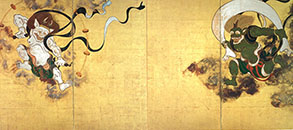 “Wind and Thunder Gods” by Tawaraya Sotatsu (Edo period, 17th century), Celebrating the 350 the Anniversary of Ogata Korin’s Birth, Treasures by Rinpa Masters – Inheritance and Innovation (Tokyo National Museum, 2008), I-44.
 Left: Seigai wave, Center: Korin wave, Right: Tatsunami
- The craftsmanship cultures of Kyoto and Edo are combined in Takotsubo GASSAI-BAG. It is a noble and gratifying work created by craftsmen putting heart and soul in their works.
◎ The design of "Octopus trap on the waves"
From the octopus trap pattern of the original design, fine adjustments were made toward the production of textiles, and the Nishijin-ori version of the design was born. The color matching this time was based on navy blue and developed by changing the color of the silk thread (white wave, blue wave, moon wave)
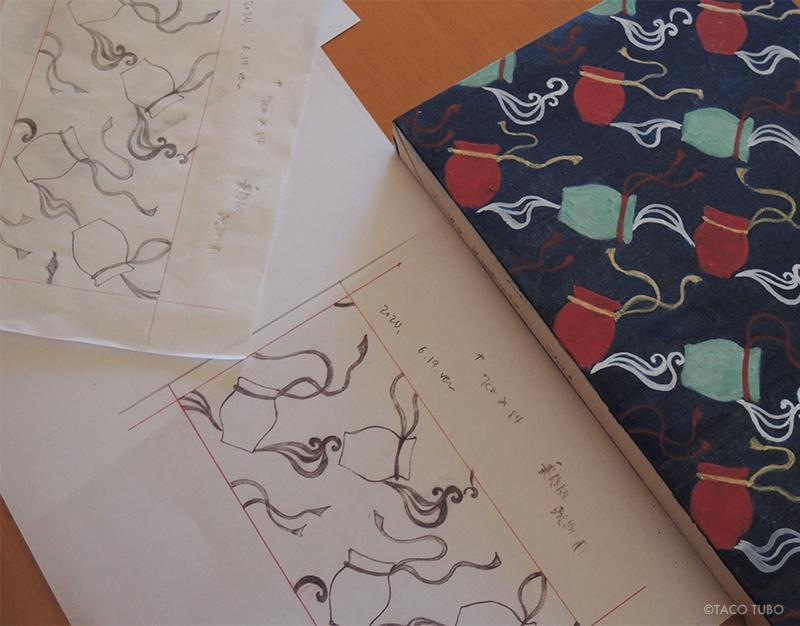 The painting for “white(shiro) wave”
- ◎ To textile production in Kyoto
It was carefully woven by the traditional Nishijin-ori brocade Orimoto. The warp and weft are spun and woven from the silk moth's cocoon by Orimoto's weaving technique, the result being a silky luster with a distinctive presence and a unique texture.Orimoto workshop, who mainly works on traditional Japanese patterns, connects the traditional techniques of Nishijin-ori to the future while innovating the gold woven fabrics used for the decoration of Houe (traditional clothing for monks), Kesa (sophisticated monk neck woven accessory), and shrines and temples
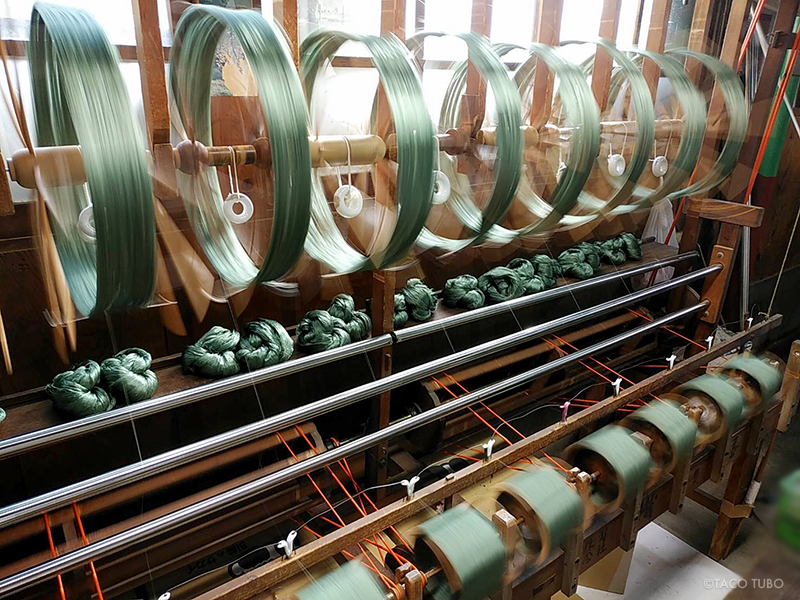
Reeling Machine
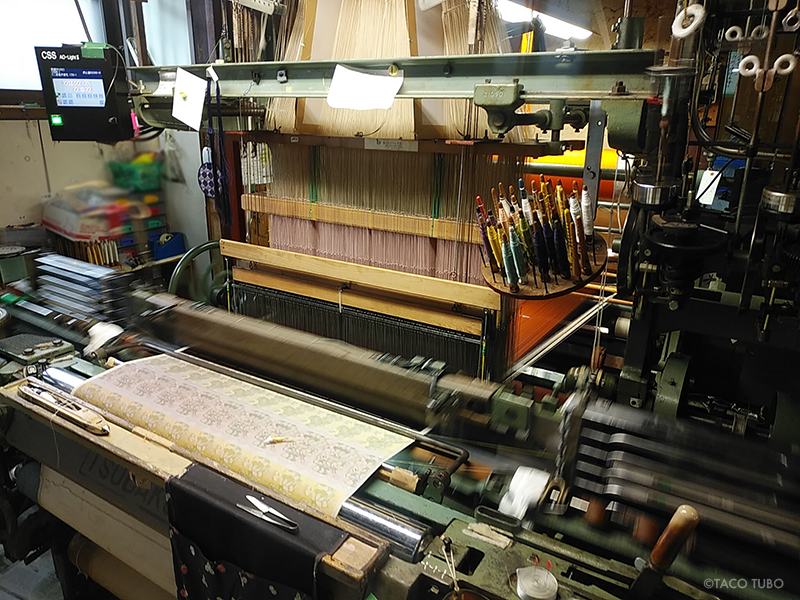
Loom
The textile expression of "Shironami" is weaving type (weft brocade): Pure silk (deep navy blue) is passed through the warp threads, and pure silk (navy blue, white, red, light cobalt green) and rust foil are used for the weft threads to create the "Octopus trap” pattern.
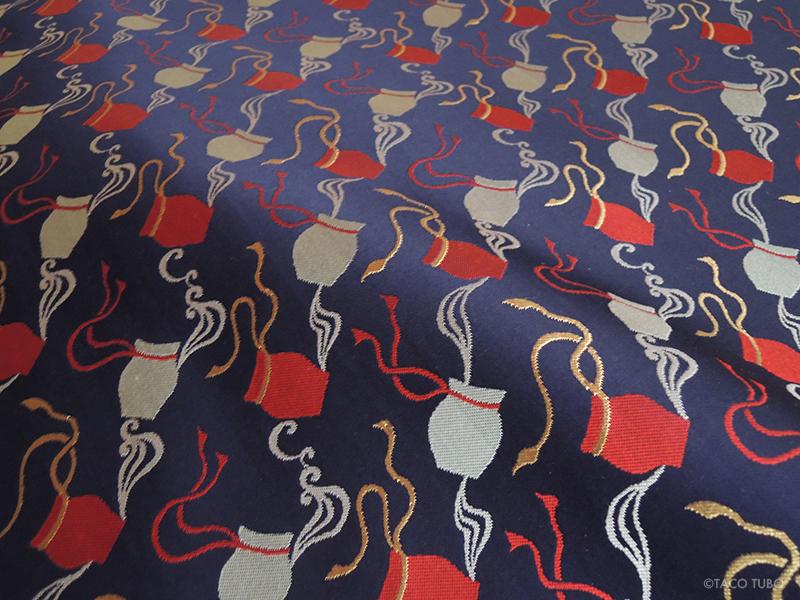 For more info about Nishijin-ori weaving, see the Association for the promotion of Traditional Craft Industries:
〇Kogei Japan Website, [https://kogeijapan.com/locale/en_US/nishijinori/] accessed Nov. 10, 2021.
〇Nisijin ori weaving / Japan traditional crafts Aoyama Square, [https://www.youtube.com/watch?v=B3JdxI9e0yg] accessed Nov. 10, 2021
◎From the woven fabric to the completion of a traditional Japanese bag in Tokyo
Through the hand-work of skillful craftsmen who inherited the traditional techniques of Edo pouch manufacturing, each component was carefully assembled into a very unique traditional bag.
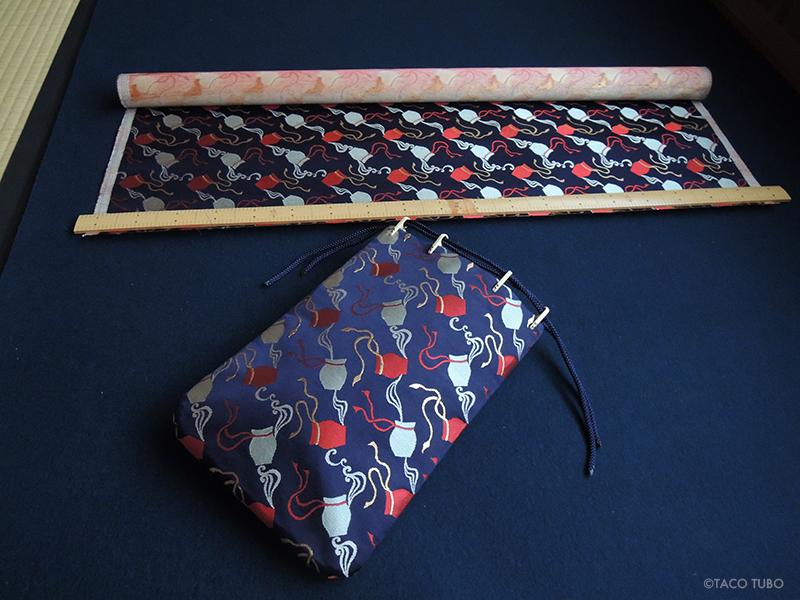
Benefiting the skills legacy granted by the craftsman winner of the gold sack of the 1938 World's Fair in Paris, the assembling is done in a workshop specialized in the making of kireji bags that suit modern life while preserving the tradition of Edo pouches.
"Edo Pouch" is evolving through the times. Japanese traditional clothes such as kimonos have survived centuries to still be present in our lives nowadays. However, the word "kimono" was coined to distinguish it from the Western clothes that entered Japan during the Meiji era. In the Edo period, people wearing traditional Japanese clothes would accessorize them with various Edo pouches and cases such as cigarette holders or medicine boxes that were hung from the waist through a practical and stylish sash bags or pouches. People's needs and consequently their personal belongings have changed with the times, but we continue to cherish the "Edo Pouch" concept which is still alive and versatile.
For more information on Edo Pouch culture, please visit the following website.
○ Kyoto Women's University Lifestyle Design Institute "Edo Pouch" google Arts & Culture exhibit website [https://artsandculture.google.com/exhibit/mAJCSA601WWbLQ?hl=ja] accessed Nov. 10, 2021.
◎The loop end attached to the end of the string
We chose lacquer drawstring stoppers that matches the overall texture and finish Each and everyone of these stoppers is lacquered by hand using traditional techniques.
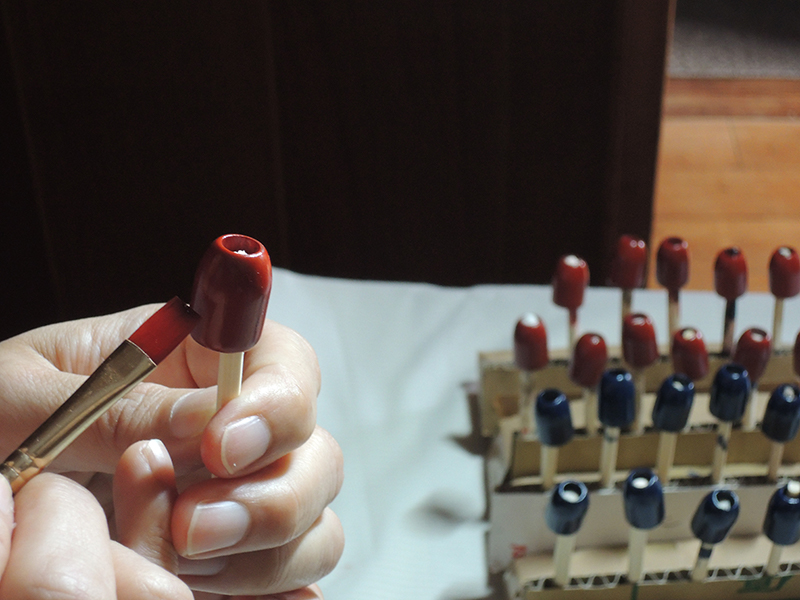
A very unique "Takotsubo" GASSAI-BAG born from "Japanese craftsmanship"
to accompany you in your daily life.